BIOMAG
The Project is partially funded by the M-ERANET 2018 call through different funding Agencies : Agencia Estatal de Investigación-Spain (PCI2019-103600 and PCI2019-103715) and Ministrstvo za Izobrazevanje, Znanost in Sport-Slovenia.
About BIOMAG
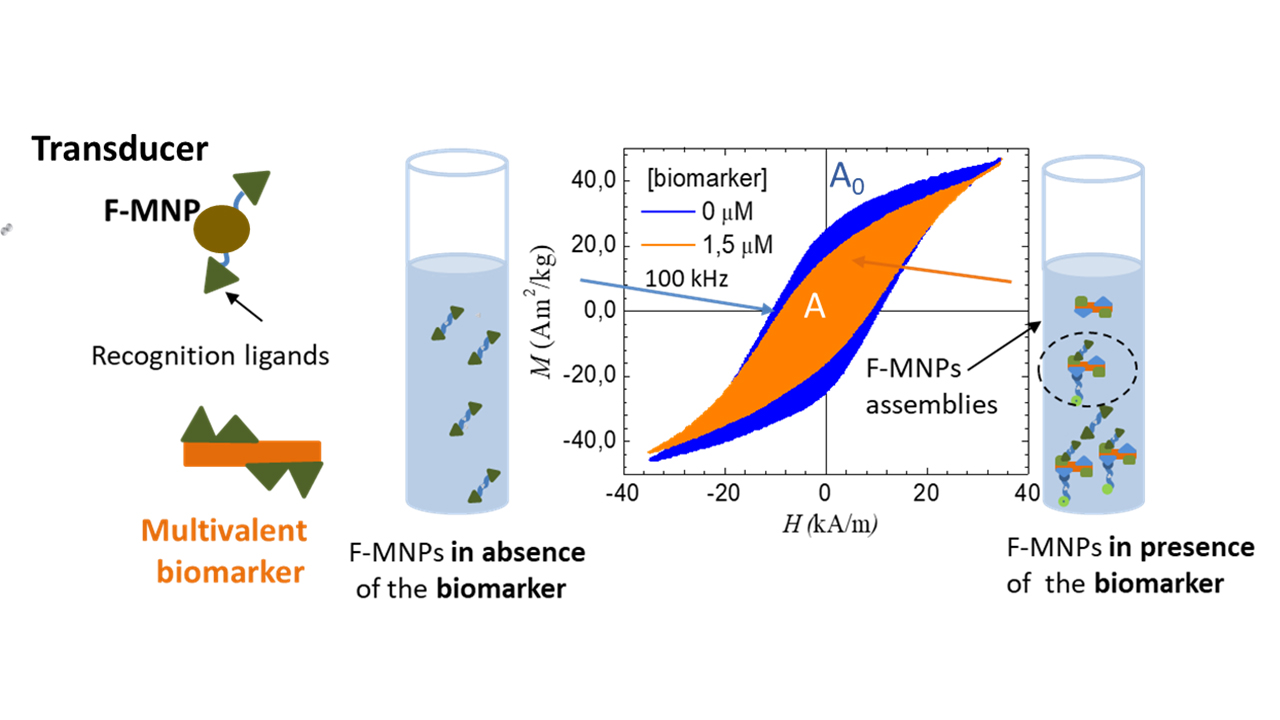
An ever-increasing number of medical applications is adopting nanotechnology to go beyond the current state-of-the-art. BioMag is a funded M-ERANET 2018 project aims to provide a quick, sensitive, reliable and low-cost in vitro diagnostic methodology based on functionalised magnetic nanoparticles (F-MNPs) for detection of biomarkers dispersed in biological fluids.
The project aims to 1) design F-MNPs with recognition ligands that specifically interact with cardiac biomarkers related to myocardial infarction and MNP surface engineering to minimize unspecific interactions with off target biomolecules present in blood samples; 2) monitor changes of AC hysteresis loops of F-MNPs after specific interaction with biomarkers; 3) develop numerical simulations to model the variation of the AC hysteresis loops for quantifying the biomarker amount present in the studied sample. The BioMag consortium gathers excellent and multidisciplinary research teams for approaching material science fundamentals towards market applications.
The project aims to:
1) Design and fabrication of transducers based on F-MNPs with recognition ligands that specifically interact with cardiac biomarkers related to myocardial infarction. MNP coating will include surface engineering to minimize unspecific interactions with off target biomolecules.
2) Monitor changes of AC hysteresis loops of F-MNPs after specific interaction with biomarkers
3) Model the variation of the AC hysteresis loops for quantifying the biomarker amount present in the studied sample.
The BioMag consortium gathers excellent and multidisciplinary research teams for approaching material science fundamentals towards market applications.
The Consortium
IMDEA Nanociencia (IMDEA) is a non-profit foundation created by initiative of the Regional Government of the Community of Madrid in order to shorten the distance between the research and society in the Madrid region and provide new capacity for research, technological development and innovation in the field of nanoscience, nanotechnology and molecular design.
IMDEA team is involved in different tasks related to 1) synthesis, functionalisation and physico-chemical characterisation of F-MNPs; 2) determination and analysis of the experimental AC hysteresis loop results; 3) setting the optimal experimental conditions for ELISA and magnetic detection methodology.
IMDEA team has solid background on 1) synthesis by chemical routes and characterisation of physico-chemical properties of MNPs; 2) MNP functionalisation with recognition ligands by covalently binding antibodies, peptides, aptamers; 3) developing customised, portable, reliable AC magnetometer; 4) assessing the influence of extrinsic and intrinsic parameters on the AC hysteresis loops. The magnetic detection methodology proposed by BIOMAG is intellectually protected by the International patent PCT/EP2018/080662.

The National Institute of Chemistry (NIC) is a scientifically excellent, established and breakthrough research institution based in Europe. With its cutting-edge research, NIC is enriching the global treasury of knowledge by solving the most pressing challenges facing society including: health, sustainable energy, climate change, a circular economy and safe food. The research goals push the boundaries of science and create new values.
NIC team will be involved in different tasks related to 1) modelling the hydrodynamic F-MNP and biomarker assembling in presence and absence of other off-target serum proteins resulting in unspecific interactions; 2) determining empirical expression to quantify biomarker amount present in sample out of simulating variation of AC hysteresis loops of F-MNPs after specific interaction with biomarker.
NIC team has solid background on 1) multiscale molecular dynamics (MD); 2) open MD; 3) non-equilibrium MD; 4) Brownian hydrodynamics, 5) nanofluidics.
Universidad de Alcalá (UAH) is an academic and research institution funded on 1499 at the same time the Spanish vanguard of the Renaissance and humanist thought in Europe. In addition to classical humanistic studies and the social sciences, UAH has incorporated the most modern qualifications in all scientific fields, such as Health Sciences and the various engineering sciences spread across its campuses, which with the Science and Technology Park are a decisive factor in its international profile and a boost to business in Madrid region.
UAH team will be involved in different tasks related to 1) MNP surface modification to minimise unspecific interaction with serum proteins by anchoring dendrons and neutralising final net surface charge; 2) neutralising the net surface charge of F-MNPs; 3) providing chemical groups for anchoring linkers.
UAH team has solid background on 1) organic and inorganic synthesis; 2) dendrimer chemistry and the biological and biomedical applications; 3) analytical and physico-chemical characterisation of dendrimers and polymers; 4) Biophysical measurements probing interactions between dendrimers and biomolecules.

KUN team will be involved in different tasks related to 1) modelling the AC hysteresis of F-MNPs for simulating the variation of AC hysteresis loops of F-MNPs after specific interaction with biomarker; 2) determining empirical expression to quantify biomarker amount present in sample out of simulating variation of AC hysteresis loops of F-MNPs after specific interaction with biomarker.
KUN team has solid background on theoretical works related to dynamic magnetic behaviour of MNPs in colloidal suspension: 1) numerical simulation on Brownian and Néel magnetisations mechanisms; 2) AC hysteresis loops of MNPs at different field (i.e. field frequency and intensity), magnetic anisotropy, environmental viscosity or particle size conditions.
News
La UAH, participa en el proyecto BIOMAG, que detecta dolencias cardíacas a través de biomarcadores en fluidos biológicos
El proyecto BIOMAG desarrollará una metodología de detección de biomarcadores en fluidos biológicos para dolencias cardíacas
El proyecto BIOMAG desarrollará una metodología de detección de biomarcadores en fluidos biológicos para dolencias cardíacas